
By Emily Saaen, Elite Senior Coach Edited by Felicity Lovelace • Reading Time: 6 minutes Introduction As both a vocal coach and audio producer, I sometimes encounter singers who believe technology can replace proper vocal training. Recently, a new student’s comment sparked an important discussion about pitch correction and vocal health: “I don’t really need […]
By Emily Saaen, Elite Senior Coach
Edited by Felicity Lovelace • Reading Time: 6 minutes
As both a vocal coach and audio producer, I sometimes encounter singers who believe technology can replace proper vocal training. Recently, a new student’s comment sparked an important discussion about pitch correction and vocal health:
| “I don’t really need to work on intonation, I got Melodyne for that. But I’ve been blowing my voice out live lately, 20 min into the set. So, I thought I’d book a lesson with a voice coach to get some singing tips and tricks.” |
…And then I got on my soapbox 🙂
What a lot of non-singers, and just very fresh singers, do not realise – is that:
PITCHING is THE RESULT of proper training of one’s entire set of vocal skills – they’re all connected like instruments in an orchestra:
Think of processing like putting an Instagram filter on a photo – it doesn’t just affect one element. Any processing (pitch correction, compression, reverb) affects ALL aspects that make your voice unique. Yes, modern tools like Melodyne allow more surgical edits than ever – you can correct centre pitch while preserving vibrato, for example. But even at its most precise, pitch correction still reshapes the subtle details that make you YOU: the natural drift between notes, the dynamic attack in metalcore or soft onset in RnB, the micro-variations that give your voice its character. And you are not a MIDI-file!
Before I go further – this is not an anti-technology rant. Auto-Tune has a fascinating creative history, and it’s worth knowing.
The first time Auto-Tune was used as a deliberate vocal effect in a commercial recording (that I can remember) was Cher’s “Believe” in 1998. Producer Mark Taylor cranked the software’s Retune Speed setting to zero – something the tool was never designed for – and created that robotic, stepping quality on Cher’s voice. And here’s the thing: it was tastefully done, accentuating specific moments rather than drenching the whole track. Cher herself insisted the effect stay when Warner Bros. wanted it removed. The Antares Auto-Tune manual later named the zero-speed setting “the Cher Effect” (Sound On Sound, Feb 1999).
Then everyone caught up. Within a year, the Europop and dance-pop scenes ran with it. Italian group Eiffel 65 built their 1999 hit “Blue (Da Ba Dee)” around heavily processed vocals directly inspired by “Believe.” Pop acts across the UK and Europe – from Steps to Madonna’s “Music” (2000) – started weaving vocal processing into their production. What Cher had used as a scalpel, the late ’90s and early 2000s pop machine turned into a sledgehammer.
The real game-changer came in 2005, when R&B and hip-hop artist T-Pain released his debut album Rappa Ternt Sanga and made Auto-Tune his signature instrument. And here’s the crucial point for my argument: T-Pain is an exceptional singer. Don’t take my word for it – watch his NPR Tiny Desk Concert (2014), where he performed completely raw, no effects, just his voice and a keyboard. It became the most popular Tiny Desk Concert ever. His Auto-Tune use was always a creative choice layered on top of genuine skill, not a substitute for it.
More recently, hyperpop and electropop artist Charli XCX has made Auto-Tune a central part of her sonic identity, particularly on her critically acclaimed 2024 album Brat. She’s refreshingly honest about both its creative value and its costs. On the Tape Notes Podcast (Episode 138, June 2024), she said that while she used to be able to sing in tune, constant Auto-Tune use has made her pitch lazier over time – to the point where she avoids karaoke because her ear has become dependent on the correction. That’s a pop star with a global platform essentially confirming the exact mechanism this article is about: when you let the tool do the work, the skill atrophies.
So – the problem isn’t the tool. The problem is using it as a bandaid for missing technique and expecting it to hold up night after night on stage.

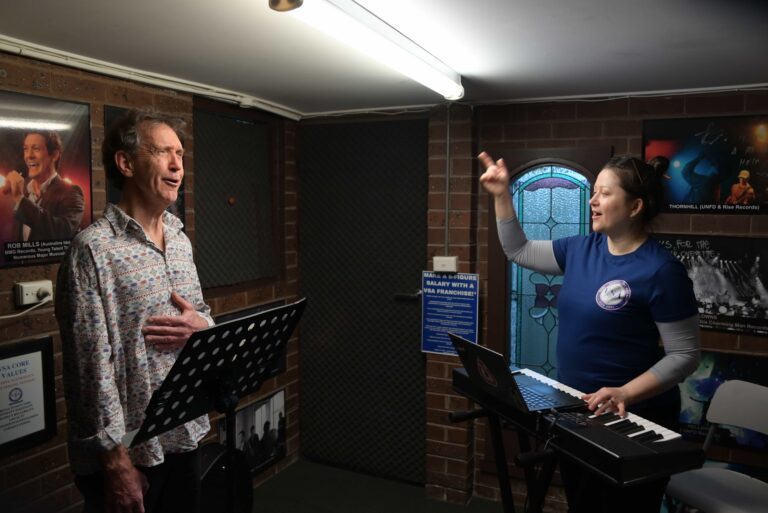
VSA student Tom Gaynor, better known by his stage name AllDay.
When we rely on pitch correction instead of proper technique, we’re actually training our muscles and brain to do the wrong thing! It’s like always using GPS instead of learning the route – you’ll get where you’re going, but you never build the internal map. Our body memorizes these incorrect patterns, making it even harder to sing correctly in live situations where there’s no safety net.
Losing our voice 20 minutes into a set isn’t just about “voice tightness” or “singing hacks”. It’s about our entire vocal setup being inefficient. When we’re not pitch-accurate, we’re compensating harmfully with too much tension, pushing too much air, or gripping with our throat muscles. It’s like trying to drive a car with the handbrake on – you’ll get there, but you’re destroying the engine in the process.
There’s a career risk here that nobody talks about either. What happens when someone asks you to sing without the safety net? At a soundcheck, a party, an unexpected duet, a stripped-back radio session? If the gap between your recorded voice and your real voice is obvious, that’s a reputation problem no amount of processing can fix. Your recording is a promise to your
Most importantly – our voice is not just a sound-making machine, it’s a part of our IDENTITY as a vocalist. When we over-process it, we’re literally erasing what makes us unique. Those little natural variations in pitch and tone? That’s your artistic fingerprint! That’s what makes listeners connect with your performance emotionally.
Even Melodyne can’t save a truly poor performance. If we decide to use pitch correction, the best results come from vocals that are already about 90% there. However, if a singer is wildly off-pitch, the processing will create artifacts, robotic sounds, and that weird warbling, metallic quality that is painfully apparent to any trained ear.
Just last week, I spent three hours helping a bandmate re-record backing vocals that could have taken 30 minutes with proper technique. The time spent “fixing” things in post-production often costs way more than investing in good vocal training!
And if you’re genuinely 90% there and just need two or three notes nudged across an entire song? That’s exactly what the tool was designed for – a quick studio fix, not a full rebuild. Sometimes it genuinely costs less to tweak two notes in post than to book another hour in the studio. That’s a smart, practical call – and it’s a world away from relying on processing to carry an entire performance.
| Key Takeaways ✓ Pitch correction should enhance, not replace, proper vocal technique ✓ Live performance requires solid fundamental skills ✓ Your unique voice is your artistic signature – preserve it ✓ Using Auto-Tune as a creative choice is valid – using it as a crutch is no t✓ Investing in proper training saves time and money in the long run |
Want to sound good live? Let’s make sure you can sing a full set without feeling like you’ve gargled glass, da? And here’s a lovely bonus – when your technique is solid, recording becomes a joy rather than a chore. You’ll spend less time (and money!) in the studio fixing things, and more time creating magic. That’s what we work on every day here at Vox SingingAcademy Australasia – building voices that don’t need a safety net 🙂
A VSA student performing ‘Falling in Love Again’ at the VSA Student Concert.
| Coming soon: what happens when AI learns to sing from a dataset full of Auto-Tuned vocals? Spoiler – it sounds exactly like you’d expect. Stay tuned. |
| About the Author Emily Saaen is an Elite Senior Coach at Vox Singing Academy with over 25 years of experience in both vocal training and audio production. Specializing in contemporary vocal techniques for studio recording and live performance, she helps singers develop sustainable careers through proper vocal technique and authentic artistic expression. |
| Ready to Transform Your Voice? Book a consultation at Vox Singing Academy today. SCHEDULE YOUR FIRST COACHING SESSION |

Professionals go to Vox and YOU can too!
VSA caters to beginners to professionals, children to seniors, teaching all styles of modern singing. Here at Vox Singing Academy, we would love to help you on your singing journey, we offer private in-studio lessons at our numerous Australian locations including Melbourne, Victoria, Sydney, New South Wales, Brisbane, Queensland and online singing lessons worldwide starting from $50!
So, contact us if you want to have fun developing the voice you’ve always wanted!
ALSO – Singing courses and private online singing lessons available worldwide, perfect for people in the United States (USA), United Kingdom (UK), Canada, Australia, New Zealand, India, Germany, Singapore, Malaysia, Thailand (Bangkok), Philippines, Indonesia.
Vox Singing Academy franchise opportunities available throughout Australasia. Make a six-figure salary with a Vox Singing Academy franchise.
VSA🎤AUSTRALASIA’S #1 SINGING ACADEMY SINCE 1993
M: 0422 278 289
E: contact@voxsingingacademy.com
VSA – Website
VSA – Franchise Australasia
VSA – YouTube Channel
The Singers Fastlane Short Course – Website
The Ultimate Online Singing Course – Website
The 5 Minute Singer/ASK VSA – YouTube Channel
VSA – Facebook
VSA – Instagram
VSA – LinkedIn
VSA – X
VSA – TikTok
Peter Vox – Facebook

This service is perfect for:
*Vocal training
*Recording studio vocal coaching
*Bands rehearsals
*Producers
*Choir work
*Directing theatre productions
*Voice production
*Pre-production vocal care
*Home visit singing lessons
*Cast or production crew lessons
*School, Tafe or University lectures or workshops
*High schools/Primary schools
*Travelling with a touring singer.
For bookings & pricing please ring 042 2278 289 or email contact@voxsingingacademy.com
His students are known to travel from interstate and overseas to utilise his wealth of knowledge and experience and now you can too!
• Full Access to Peter Vox’s entire arsenal of 5000+ vocal scales, expertise experience and knowledge on all subject matter.
• Premium Ear & Pitch Training. Peter will guarantee you to be in key and on pitch at least 99% of the time.
• Guaranteed email and phone contact with Peter Vox for any questions, help and advice with same day response by phone and 24hour response via email.
3. START AT YOUR SKILL LEVEL!
Beginner, intermediate, advanced and pro starting levels designed for males & females, children to seniors, beginners to pros.
4. UNLOCK YOUR FULL SINGING POTENTIAL NOW!
Our Guarantee to you is that you will hear and feel a vast improvement in your singing voice in just 3 weeks if you follow the courses instructions.
Incredible Value! Get Access To All 4 Courses!
Total duration of all 4 courses – 16 hours 24 minutes
Total vocal scales work out duration for all 4 courses – 11 hours 4 minutes
Courses start at $29.95
The Ultimate Online Singing Course is the most comprehensive & affordable online singing course available!
You won’t need to search any further as every thing you need to know about singing is contained in these courses!
Our Guarantee to you is that you will hear and feel a vast improvement in your voice in just 3 weeks if you follow the courses instructions.
So come and unlock your full singing potential now along with thousands of others that have improve their singing abilities with Vox Singing Academy's Ultimate Online Singing Course.
Learn More About The Ultimate Online Singing Course.
Topics that can be covered in workshops
Correct vocal warmups & cool downs
Correct diaphragmatic breathing techniques
*Pitch and ear training
*Personally recorded and customised scales workout
*Microphone technique, stage presentation and crowd interaction.
*Songwriting and/or preproduction of songs
*Vocal care and health
*Anatomy and how the voice works
*Vocal coaching for extended periods of touring, performing and recording.
*Harmonies
*Vocal health & general fitness
*Question and answer session
Classes are 4 or 8 hour sessions between 11 am to 7 pm weekdays and 10 am to 5 pm on Saturday or Sundays. For prices please click here!
For prices and bookings please click here!
So what are you waiting for? Let VSA give you the voice you've always wanted!
The event is held on Sundays generally starting at 1 pm at a venue specified by your teacher. Food and drinks are available. Family, friends and the public are welcome.
Prizes, giveaways, Vox Singing Academy gift vouchers and merchandise will be given away at the end of all concerts.
Key advantages with online singing lessons.
Save time & money.
Flexible times worldwide 7 days a week.
* Record your entire singing lesson on video for future reference.
* Have lessons where and when you want!
* In class you have to stand directly in front of camera. This is a HUGE key advantage over in studio lessons as the teacher can see you closely & monitor you’re breathing & mouth placements for correct articulation, pronunciation & diction.
* All student can clearly hear & see the teachers demonstrations as teacher is mostly directly in front of their camera.
For prices please click here!
Key advantages with online singing lessons. Consistent practice is the key to improvement!
Save time & money.
Flexible times worldwide 7 days a week.
* Record your entire singing lesson on video for future reference.
* Have lessons where and when you want!
* You have to stand directly in front of camera. This is a HUGE key advantage over in studio lessons as the teacher can closely
monitor you’re breathing & mouth placements for correct articulation, pronunciation & diction.
* All student can clearly hear & see the teachers demonstrations as teacher sits directly in front of their camera.
* Perfect if you are travelling, live in a remote area or have transport or mobility issues.
So what are you waiting for? Let VSA give you the voice you've always wanted!
